
At a Glance
- What SBTi is: A voluntary global initiative that validates whether corporate climate targets align with climate science.
- What it does well: Creates credibility, standardisation, and ambition around emissions reduction targets.
- What it does not do: Assess plans, budgets, governance, resourcing, or delivery capability.
- Who benefits most: Companies seeking external credibility and internal momentum for climate targets.
- What to pair it with: A climate transition plan, budget and capex alignment, clear ownership, and robust GHG inventory
Introduction
For many companies navigating climate ambition, one question keeps coming up early in the journey. What is SBTi, and is it worth doing?
The Science-Based Targets initiative has become a recognisable signal of climate credibility. In January of this year the 10,000th company got their targets validated, and many more are considering whether it should be part of their climate strategy.
At its core, SBTi is a useful framework. It brings structure, comparability, and scientific grounding to corporate climate targets, but it is also incomplete on its own. SBTi‘s validation confirms whether targets align with climate science. It does not assess whether a company has a funded plan, the right resources, operational ownership, or a realistic pathway to deliver those targets.
Understanding both sides. What SBTi does well and where it falls short is essential for companies that want ambition and execution.
What is SBTi? (Science-Based Targets Initiative Definition)
The Science-Based Targets initiative is a voluntary global framework that helps companies set greenhouse gas reduction targets aligned with limiting global warming to 1.5°C as per the Paris Agreement. It focuses on whether a company’s targets are ambitious enough, cover the right emissions scopes, and follow recognised methodologies of specific sectors.
In practical terms, SBTi requires companies to:
- Set near-term science-based targets (5–15 years)
- Create a complete GHG inventory for Scope 1 & 2 and Scope 3 of the entire organisation
- The target to cover Scope 1, Scope 2, and, where relevant, Scope 3 emissions
- Submit those targets for independent validation
- Report progress publicly on an annual basis
SBTi does not tell companies how to reduce emissions; it validates the completeness of the emissions and the ambition level of the target, and that distinction matters.
While European-headquartered companies still make up a substantial share of the 10,000, growth in Asia has accelerated in recent years. Investors, customers, and procurement teams increasingly expect SBTi-aligned targets as a baseline for credible climate ambition, regardless of shifting regulatory timelines.
Why SBTi Became the Default Credibility Signal
SBTi emerged at a time when climate commitments were plentiful but often vague. Targets lacked consistency, timeframes varied wildly, and claims were difficult to compare.
SBTi addressed that gap by offering:
- A science-based ambition benchmark
- Consistent methodologies across sectors
- Third-party validation rather than self-declaration
For investors, this created comparability. For customers, it offered reassurance. For boards, it provided a defensible reference point in climate discussions. In an environment shaped by EU climate goals, growing scrutiny of corporate climate targets, and increasing focus on scope 1, scope 2, and scope 3 emissions, SBTi became shorthand for seriousness.
Who is SBTi for?
SBTi serves companies of all sizes, though uptake varies by sector. Manufacturing, technology, consumer goods, and financial services show the highest adoption rates, driven by investor scrutiny and supply chain pressure.
The initiative offers different pathways depending on scale. Large corporates follow the standard route with a detailed scope 3 assessment. SMEs with fewer than 500 employees can use a streamlined pathway with simplified requirements and lower fees.
SBTi tends to be most relevant when investors or customers expect validated targets, scope 3 emissions are significant, or the organisation operates in markets with high climate expectations. For companies earlier in their climate journey, building insights and governance capability may be a more practical first step.
Strengths: What SBTi gets right
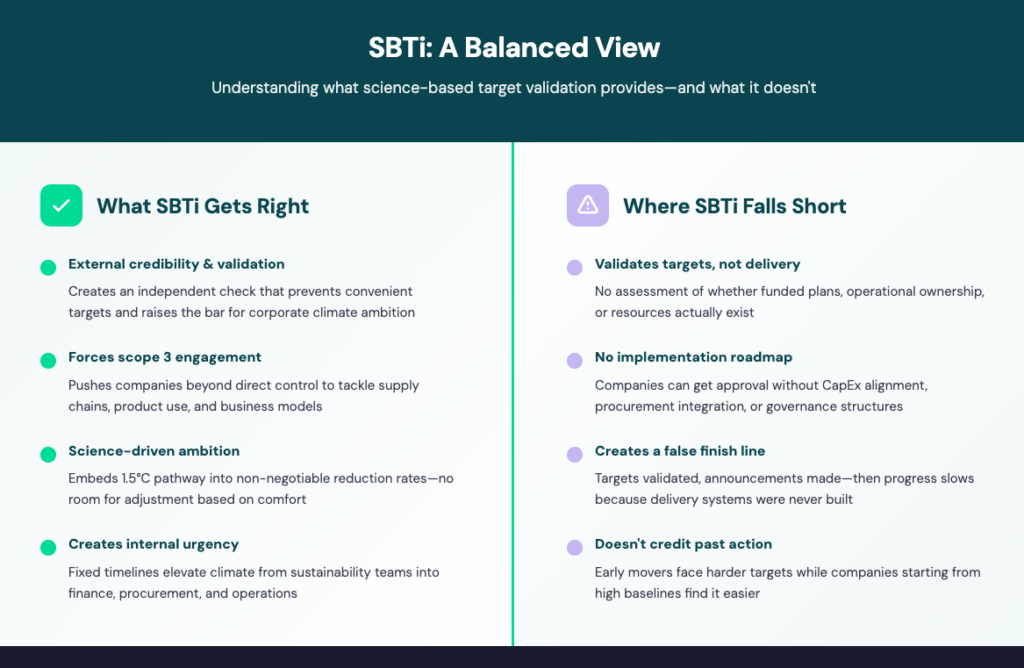
One of SBTi’s biggest strengths is credibility. Validation creates an external check that makes it harder to set targets that are convenient rather than meaningful. That alone has raised the bar for corporate climate ambition.
SBTi also forces companies to confront scope. Many organisations would prefer to focus on emissions they directly control. By requiring scope 3 consideration where it is material, SBTi pushes companies to engage with supply chains, product use, and business models. This often surfaces uncomfortable but necessary conversations.
Equally important is that SBTi eliminates argumentation around ambition. The ambition levels are embedded directly in the target-setting tools and translate the science of the 1.5°C pathway into non-negotiable reduction rates. There is no room for companies to adjust targets based on what feels feasible or comfortable. While this can be experienced as overly ambitious (particularly by organisations that have already made progress) it ensures that climate science, not corporate preference, sets the standard.
Another strength is internal urgency. Once a commitment is made, timelines are fixed. Targets must be developed and submitted within a defined window of two years. That pressure can elevate climate discussions from sustainability teams into finance, procurement, and operations.
For example, a mid-sized EU manufacturer with significant purchased goods emissions may use the SBTi process to uncover that the majority of its footprint sits outside its own operations. That insight alone can reshape supplier engagement and procurement priorities.
Limitations: Where SBTi falls short
This is where many companies underestimate what SBTi does. SBTi validates targets; however, it does not validate delivery.
During SBTi validation, no one checks whether a company has:
- A funded emissions reduction plan
- Operational ownership for delivery
- CapEx & OpEx aligned to climate priorities
- Procurement requirements linked to scope 3 targets
- Internal governance and decision cadence
- Resources to implement change
As a result, it is entirely possible for a company to receive SBTi approval and still be unprepared to act.
In practice, this creates a common pattern. Targets are validated, announcements are made, and then progress slows. Delivery systems were never built, budgets were never aligned, and responsibility remains concentrated in a small sustainability team without decision authority.
SBTi also does not credit past reductions, which can disadvantage early movers while making target-setting more straightforward for companies starting from a higher baseline.
SBTi is not designed to solve this problem.
The Most Common Ways SBTi Gets Misused
One frequent misuse is treating SBTi as a badge, and validation becomes an endpoint rather than a starting point. The organisation moves on to the next priority without embedding the work required to deliver impact or reductions.
Another is confusing validation with readiness. Approved targets can create false confidence, even when data quality is poor or scope 3 assumptions are fragile. This often leads to rework (e.g., adapting baseline and targets) later.
A third shortfall is announcing ambition without governance; there are many organisations that commit to SBTi but ultimately fail to set a validated target. Public net-zero language is used, sometimes without clarity on how SBTi near-term targets connect to long-term climate transition plans. This confusion is explored further in our article on SBTi vs net-zero.
When SBTi Works Best: What Companies Need Beyond Validation
Used well, SBTi can be a powerful anchor for action. The difference lies in what companies build around it.
Strong practice includes:
- A climate transition plan that prioritises reduction levers over time
- A solid GHG inventory with insights into the entire organisation
- Clear budget and CapEx alignment with emissions goals
- Named owners for each major reduction lever
- A realistic approach to scope 3 engagement with your up and downstream value chain
- Acceptance that trade-offs and learning are part of the process
In this context, SBTi provides direction, while the organisation builds the machinery needed to move. This is where many companies benefit from stepping back and asking not just if our targets are valid, but if they are deliverable.
Should You Use SBTi?
Many companies wonder if SBTi is required, but it is not mandatory.
SBTi often makes sense when:
- External credibility is important
- Scope 3 emissions are significant
- Investors or customers expect alignment
- The organisation is ready to operationalise targets
It may be premature when:
- Emissions data is highly uncertain
- Ownership and governance are unclear
- There is no realistic path to implementation
Before committing, boards should ask a more fundamental question, are we willing and able to follow through on the level of ambition this commitment requires? Without answers, commitment creates pressure without direction.
Conclusion
SBTi plays an important role in the climate landscape. It brings credibility, comparability, and ambition based on scientific grounding to corporate climate targets. For many organisations, it provides the external signal that ambition is taken seriously.
SBTi is not a strategy; it does not allocate budgets, assign responsibility, or deliver emissions reductions. Those elements sit firmly within the organisation.
When paired with a clear transition plan, governance, and resources, SBTi becomes a strong foundation. Without them, it risks becoming another well-intentioned commitment that struggles to translate into action.
Frequently Asked Questions
SBTi is a voluntary global initiative that validates whether corporate greenhouse gas reduction targets align with climate science and 1.5°C pathways.
No. SBTi is voluntary, but it is increasingly expected by investors, customers, and supply chain partners globally as a credibility signal.
SBTi validates targets on completeness and ambition. It does not assess budgets, reduction plans, governance, or whether a company can realistically deliver those targets.
It’s validation, not certification. SBTi reviews and approves targets based on scientific criteria but does not certify companies or their operations.
Yes. Without a climate transition plan, budgets, and ownership, SBTi targets often remain aspirational rather than actionable.